Beyond ChatGPTBuilding Your AI Operating System
Almost everyone chats with AI. Almost nobody has a system. This page walks through the talk in order, with the charts, the three demos, the sample skills, and every source, so you can pick up where we left off.
The arc of the talk
Why a system
Chatting vs. an AI operating system
Where to start
Sort your data. Write one page of rules.
AI research
Gemini Notebook: answers grounded in your sources
Skills
A meeting prep brief skill in Claude
Vibe-coded app
A capital call calendar built in ChatGPT Codex
Cost and tokens
Why the bill still goes up
Security
The bad guys have AI too
Where the model lives
From chat app to self-hosted
Start small
One problem, one owner, one number
FAQ and sources
Questions, glossary, citations

"Make sense of AI. Then make it useful."
I've always worked where people, processes, and technology meet. 25 years in that space, advising small businesses, and more than 1,000 professionals and business owners trained this past year. The technology is the easy part. Getting people to trust it and build it into real work is the hard part.
Chatting with AI is not a system
A chat window starts from zero every time. A system remembers what matters, repeats what works, and stays inside rules you set.
Chatting
- Starts from zero every time
- Lives in one app, on one laptop
- You copy and paste between tools
- Free tools can train on your data
Your AI system
- AI has context it can draw on
- Repeatable workflows
- Agents that act proactively
- Clear guardrails
Your AI Operating System
Your context, your workflows, your agents, all inside your guardrails.
Context
What AI knows about you: history, people, entities, past decisions and why you made them.
Workflows
The repeat jobs it runs the same way every time. Skills live here.
Agents
It takes steps on its own, and proposes before it acts. A person decides.
From Efficiency AI to Opportunity AI
How can we do this current task faster?
Summarize these reports. Draft this memo. Code expenses. Prep the agenda.
What can we build that was not possible before?
A private-deals dashboard. A giving tracker. A "Family Brain." A capital call calendar, like the one in Demo 3.
The era of "personal software": describe the tool you need, and AI can build a working draft in minutes.
Agents just landed on everyone's phone
Four agent launches in seven weeks. Your parents, kids, and staff may meet agents before your family office decides how to use them.
Muse
Free. Personal life, consumer tasks, shopping, bookings, and errands.
Grok Bot
A team of bots is the easiest way to picture an agent. X access for research.
dots
Works inside ChatGPT, so it can drive your cloud and local threads.
Claude Duet
Proactive out of the box. Asks before it sends, pays, signs, or deletes.
First AI exposure for many: free, for now. "Free" is a privacy question. Ask what the business model is.
Sources: Meta newsroom, Sept 8, 2026; x.ai, Sept 3, 2026; TechCrunch, Sept 29, 2026; MacRumors, Oct 21, 2026.
Start with zero trust for autonomous agents on your computer.
The point made by NVIDIA's Jensen Huang, whose company sells the hardware that runs all of this. Our version of the rule: agents propose, a person decides.
Voice: talk, don't type
If you can brief a colleague, you can brief your AI. Dictate the memo as you leave the meeting, while the context is fresh. It's the easiest on-ramp for parents, grandparents, and busy principals.
One caution: voices can be cloned. Money requests get confirmed on a number you already have.
AI went from 30 seconds of work to a full workday
How long a task AI agents can complete on their own
What tasks of that length look like
Caveat: METR measures tasks a model finishes about half the time, mostly software work. The trend is the point, not any single number.
Source: a16z on X, Oct 2026, citing METR research on AI task length.
The capability gap is expanding. AI can already do far more than what most of us ask of it. Most people still use it like a smarter search box.
The bottleneck is context, not intelligence
"The models are smart enough, but they just don't have the context that exists inside of any organization."Ali Ghodsi, CEO, Databricks
"Even the smartest human would be all but useless without access to the company's data, permission to act, feedback, or the knowledge in other employees' heads."
Source: Ali Ghodsi, quoted by a16z on X, Oct 2026.
Smart enough already
Lives inside your family and your office, not inside the model. Your history, people, entities, and the reasons behind past decisions.
Bars are illustrative.
"Own the context. Rent or replace the model."
ChatGPT, Claude, Gemini, open-weight models: rent whichever is best this year. The model is replaceable. Your family's judgment, knowledge, and strategy are not. Keep those assets under your control, in files you own, so you can switch models without losing what you've built.
Source: adapted from McKinsey, "Own the context; rent or replace the technology," in "The AI operating system," Oct 2026.
ChatGPT
Claude
Gemini
Open-weight models
Your family's context: decisions, history, rules, skills
Family offices: enthusiasm is running ahead of measurable results
say AI is core to their operations or increasingly important
report no measurable impact from AI adoption
name cybersecurity and data breaches their top near-term concern, up from 16% the year before (RBC and Campden Wealth)
How family offices that use AI in investing use it
Sources: BlackRock 2026 Americas Family Office Survey (206 single family offices, fielded Jul 13 to Aug 24, 2026); RBC and Campden Wealth, North America Family Office Report 2026.
Everyone is building a second brain
Y Combinator wants to fund a "Company Brain": company rules turned into skills AI agents can run. McKinsey calls it the AI operating system. A family office can build its own version now.
What your office knows
Inboxes, PDFs, people's heads
Rules and history, written down
So AI can use them, and so the knowledge survives when people move on
Source: Y Combinator Requests for Startups, Summer 2026; McKinsey, "The AI operating system," Oct 2026.
Where to start building your AI OS
Two moves before any tool: sort your data, and write one page of rules. An afternoon, not a project.
1. Categorize your data before sharing it with AI
Go
Public filings, published articles, and templates with no names.
Careful
Internal drafts, agendas, and deal summaries with names removed.
Stop
Account numbers, tax IDs, legal advice, family medical details, and NDA deal materials.
When in doubt, move it up a level. Every demo in the talk was labeled with one of these colors.
Source: Avihay Zanetti, "AI Policy for a Family Office: Ten Questions to Ask," Oct 2026.
2. Create a one-page AI policy
- Approved tools and plans. Name the tool and the plan. A free personal account is a different decision from a business plan.
- Know what the vendor keeps and trains on. Read the terms for the plan you use.
- A person decides. AI drafts and proposes. People approve.
- Agents get least access. Read and draft first. Send, pay, or delete only with approval.
- Our knowledge stays ours. Keep the family's context in files you control.
"AI does not send messages or move money."From Avihay Zanetti's family office AI policy template
Three questions to answer this week:
- Which tools and which plans are approved?
- What does the vendor keep, and does it train on it?
- Who approves a new tool?
Start your one-page policy in the AI Plan template
3 questions before AI touches family data
Have you read the Terms of Use?
Who sees it, how it's used, how long it's kept.
Could your investment strategy leak?
Off-the-shelf tools see whatever you paste.
Who owns your family's institutional intelligence?
Who controls what the AI remembers?
Each one was answered inside a demo: the account type (Demo 1), a workflow that never needs your strategy (Demo 2), and a tool that runs on your own computer (Demo 3).
Your AI subscription: the account type is the privacy setting
Free, Plus, Pro, Max
- Can train models if the setting is on
- Claude: chats kept up to 5 years with training on (30 days with it off)
- Settings are per person and easy to miss
Team, Enterprise, API
- Not used for training by default
- Commercial terms, not consumer
- An admin manages access
Anything touching family money or strategy: a business account or a purpose-built platform.
Sources: Anthropic, "Updates to Consumer Terms," Aug 28, 2025; Anthropic data usage; OpenAI, "New ways to manage your data in ChatGPT."
Did you know? Your feedback to AI isn't private
A thumbs up or down is feedback, and feedback has its own privacy rules.
| Tool | What happens when you rate a response |
|---|---|
| Claude | Keeps the whole chat up to 5 years. May train models. |
| Gemini | Human reviewers may read it. Kept up to 3 years. |
| ChatGPT | May be used for training, even if you opted out, depending on plan. No retention period specified. |
Rule of thumb: don't.
Sources: Anthropic Privacy Center (Mar 16 and Jul 1, 2026); Google Gemini Apps Privacy Hub (Oct 26, 2026); OpenAI Help Center (Nov 1, 2026).
Gemini Notebook formerly NotebookLM
Organize and explore the sources you trust. It answers only from your documents, and it shows you where each answer came from.
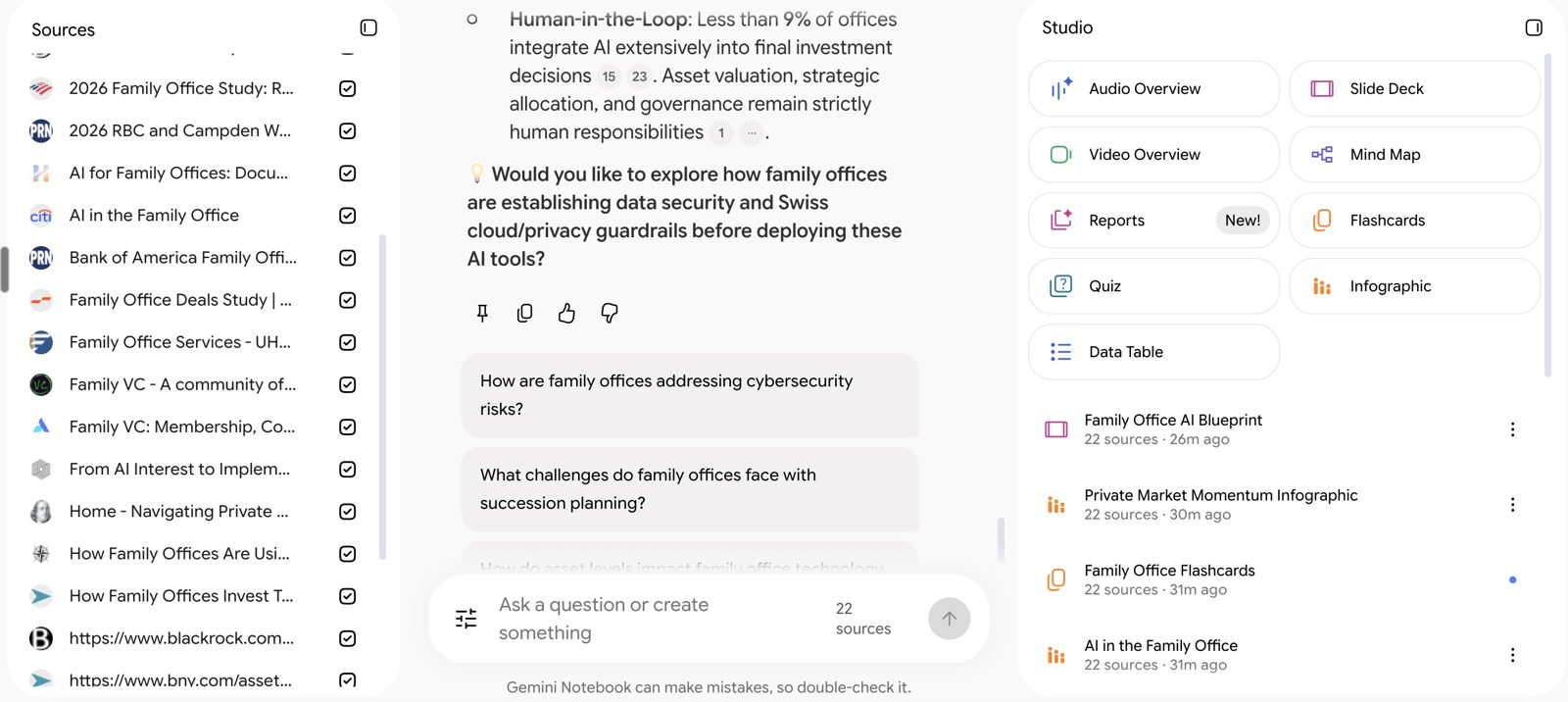
What we did
- Sources: loaded 22 public family office reports (BlackRock, Bank of America, RBC and Campden, Citi, UBS and others).
- Ask: one question about family offices and AI.
- Check: click a citation. It opens the exact passage. That's the trust move.
- Create: Studio turns sources into an audio overview, slide deck, infographic, mind map, report, or flashcards.
- Review: a person still reads it before it goes anywhere.
Source: Google Workspace Updates, "NotebookLM is now Gemini Notebook," July 16, 2026.
Which account should a notebook live in?
Training: not used to train, unless you click thumbs up or down.
Human review: feedback can be read by trained reviewers, unlinked from your account.
Retention: reviewed feedback kept up to 3 years.
Terms: Google Workspace or Cloud terms.
Training: not used to train AI models.
Human review: none, even if you give feedback.
Control: your admin turns it on and manages access.
Notebooks inside the Gemini app
These follow your Gemini Keep Activity setting. On: chats can help train models, kept 18 months by default. Off: kept 72 hours. Google says not to enter anything you wouldn't want a reviewer to see.
Rule of thumb: research documents go in a work account notebook, never a personal one.
Sources: Google Help, Learn about Gemini Notebook; What happens when you send feedback; Gemini Apps Privacy Hub (Oct 26, 2026).
Skills: tell your AI how you want it to work
A skill is a written recipe your AI follows the same way, every time. Write it once. Use it when needed.
Portable
It's just a text file, so it can move between Claude and ChatGPT.
Easy to make
After you finish a task, ask the skill creator to save the steps as a skill.
Safe to check
Read the file before you install anyone else's. You'll see every rule it follows.
What a skill looks like
capital-call-reader/SKILL.md
---
name: capital-call-reader
description: Use when a capital call notice arrives. Pulls the
details into our capital call tracker.
---
1. Read the notice. Pull the fund, amount, and due date.
2. Add one row to the capital call tracker.
3. Check the amount against our commitment and calls to date.
4. Flag if any of these are true:
   - Due in less than 10 days
   - Wire instructions differ from last time
   - Amount does not match the fund's math
5. Never send the wire. A person approves every payment.
The first lines tell the AI when this skill applies.
No code. Write it the way you'd train a new analyst.
The guardrails live in the skill, so every run follows them.
AI skill ideas for your office
Every skill has a color, and the color tells you where it can run. Go Careful Stop
Capital call reader
Pull the amount, due date, and fund from each notice into one tracker.
Investment memo drafter
Turn a pitch deck into your family's memo format. Purpose-built tools only.
Family meeting prep
Build the agenda, past decisions, and open items before each meeting.
Board or LP update summarizer
Turn a 40-page quarterly report into one page of what changed.
Philanthropy grant screener
Score each request against your family's giving values.
Next-gen learning coach
Explain a term sheet or trust document in plain words, at your level.
Example skill: meeting-prep-brief
meeting-prep-brief/SKILL.md
---
name: meeting-prep-brief
description: Use before we meet a fund manager, company, or
deal sponsor. Researches public sources and builds our one-page brief.
---
1. Ask who we're meeting and when. Names and dates only.
   Never type in our holdings, terms, or plans.
2. Search the web: SEC filings, Form ADV, BrokerCheck,
   company releases, earnings calls, reputable news.
3. Build our one-page brief: who they are, what changed,
   key numbers, red flags, 5 questions, what we don't know.
4. Cite every fact with a link and date. Show conflicts.
5. Label short-seller reports and rumors as claims.
6. Draft only. A person checks it before the meeting.
A notebook answers from what you upload. This goes and looks.
Every brief, same format, whoever runs it.
Claims labeled. Conflicts shown. Gaps listed.
The whole prompt in the demo was: "Prep me for an intro call with Cerebras investor relations next Tuesday." Notice what's missing: not what we own, not what we're thinking, not a dollar amount.
Sample brief: intro call with Cerebras investor relations (Nasdaq: CBRS)
- One customer was 62% of 2025 revenue
- 14% GAAP gross margin vs. 41% "core"
- Claim, not fact: a short seller says the chips wear out in about 2 years
- Final lockup release Nov 9
- How much of the $25.4B backlog is OpenAI?
- Why did the chips' useful life change in the IPO drafts?
- What's left out of "core" margin?
- Q3 results land Nov 12, two days after the call
- The company's answer to the short seller
- One headline says down 39%. Its own numbers say 72%.
Sources: Cerebras 8-K (Aug 12, 2026), Motley Fool (Sep 21), TIKR (Oct 29), Startup Fortune (Nov 2), Barchart. Illustrative, not a recommendation. Read the full sample brief with links.
Could your investment strategy leak? Design the workflow so it never needs your strategy. Public in, prep out, a person checks it.
A tool built for one family's question
Not old tasks done faster. A tool that didn't exist this morning, built from a plain-English description in a few minutes, using fictional data.
A next-gen family member is preparing for a family-office meeting. Capital call information is scattered across six fund notices and a spreadsheet.
"How much cash may we need, and when?"
The old answer was a software project. The new answer is to describe the tool, and let the AI build and test it.
PDFs from six managers
The skill from the idea board pulls amount, due date, and fund
One row per call, confirmed or estimate
The year at a glance, gaps and busy months flagged
The prompt is the program
PROMPT TO CHATGPT CODEX (CONDENSED)
Build a "Capital Call Calendar" as one self-contained HTML file.
No libraries, no CDN, no network requests. Must work with
Wi-Fi off. "Your file stays on this computer."

INPUT: open a CSV (Fund, Status, Due date, Amount...).
SHOW: 12-month calendar. Solid bars for confirmed notices,
hatched bars labeled "Estimate" for planning guesses.
FLAG: rows with no due date or no amount. Threshold slider
$500K to $5M (default $2M); months above it turn orange.
ALSO: four headline tiles, a table by fund, a footer:
"Estimates are planning guesses, not forecasts."

CHECK YOUR WORK: 17 rows, 6 funds. Confirmed $3.9M,
estimates $8.8M. March 2027 is $4.5M, all estimates,
the only month flagged. Two rows need attention.
If anything differs, fix it before you finish.
No data sent anywhere.
Confirmed and estimated never blend into one number.
Flags gaps and busy months at a level the family picks.
Give it known answers. The AI tests the tool and fixes its own mistakes.
The full prompt is about 590 words including the sample rows. Download the full prompt.
The finished Capital Call Calendar
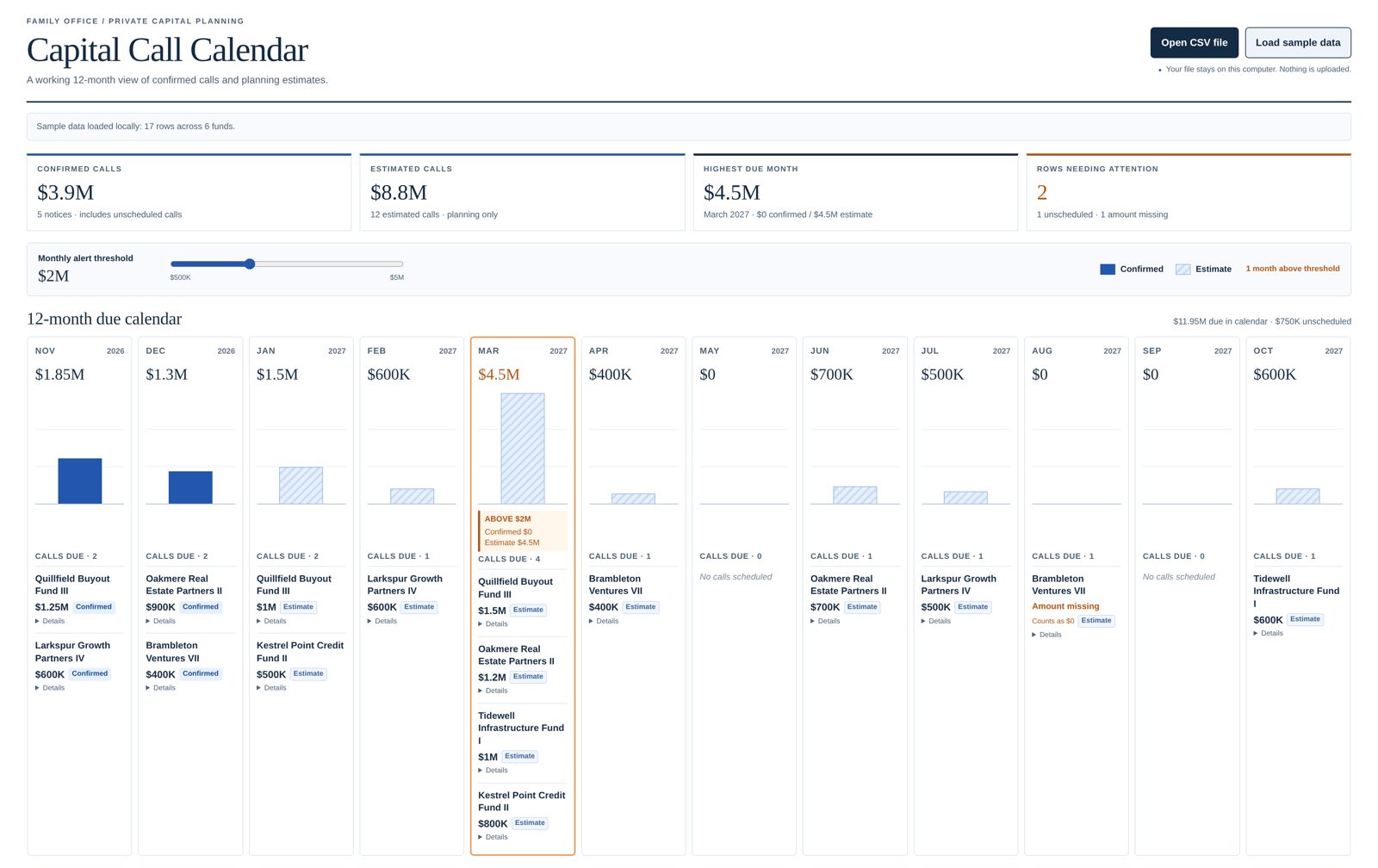
confirmed, 5 notices
estimated, 12 rows
March 2027, all estimates, the only month over $2M
rows need attention: a missing due date and a missing amount
Fictional funds and data. Click "Load sample data" in the calendar, or open the CSV. The calendar makes no network requests. On a small screen the month grid scrolls sideways.
Two privacy questions, and who stays responsible
The AI service's terms apply
The prompt and anything you paste go to the AI service, under its terms. Running locally later doesn't change that. So we built with fictional data, on a business account.
It stays on this computer
The finished tool is one file in the browser. No network calls, no accounts connected. It works with Wi-Fi off.
- Review the code. Someone checks what it does.
- Secure the computer. Patched, encrypted, locked.
- Control access. Who can open the file and the data.
This isn't a replacement for the investment team. The tool organizes and flags. The family and its advisors own the data and the decisions.
Tokens get cheaper. The bill still goes up.
When steam engines got more efficient, Britain burned more coal.
Same with AI: cheaper tokens, bigger bills.
cheaper per token since 2023
more tokens a month at Google, in one year
- Agents: dozens of steps per task
- Coding: whole codebases, again and again
- Cyber defense: scanning around the clock
Budget for AI like a utility: cap it, meter it, review it monthly.
Sources: Apollo (T. Slok) and Fortune, June 2026, citing Silicon Data; Google I/O, May 19, 2026.
Cybersecurity: the bad guys have AI too
AI cuts both ways. The defense is still a process.
- Deepfake voice and video. A faked CFO on a video call got $25.6M wired (Arup, 2024).
- Agents that get tricked. Hidden instructions in a document or email hijack the AI (prompt injection).
- Data that leaks. Pasted strategy leaves your control.
- AI finds the holes first. Anthropic's Mythos found 10,000+ flaws, one dating from 1998.
- Always-on watching. Odd logins, changed wire instructions.
- Agents that can't act alone. A person approves payments.
Sources: FBI IC3 2025 Annual Report; CNN on Arup, May 2024; OWASP Top 10 for LLM Applications 2025; Anthropic via Engadget, May 23, 2026.
Protecting the family: five habits
Family code word
Agreed in person. Never written down.
Call back
On a number you already have.
Two people for money
A second approver on new payees.
AI reads, never obeys
Hidden instructions can hijack it.
Data stays yours
Business-terms tools only.
Sources: FBI PSA on AI-enabled fraud, Dec 2024 (code word); FBI IC3 2025; OWASP Top 10 for LLMs 2025.
Proactive defense: the family office baseline
Passkeys, not text codes
Auto-update everything
Call back on every wire change
Train for the fake
Let AI watch for you
Know who to call
Start this month: passkeys on email and banks. The call-back rule. A one-page plan.
Sources: CISA, "More than a Password" (phishing-resistant MFA); FBI IC3 business email compromise guidance.
Open-weight models: AI you can own
Open weights means you download the model and run it yourself. Your data never has to leave.
Artificial Analysis Intelligence Index v5, selected models
between the best closed model you can use today (Claude Opus 5.5, 58) and the best open ones (DeepSeek and GLM, 32).
The gap is real today. It has been closing over time, and the scoring changed between index versions. Watch it.
Source: Artificial Analysis Intelligence Index v5, by open weights vs. proprietary, Oct 30, 2026. Gemini 4 Carbon (59) had no public API at the time and is left out.
Where should the model live?
Further down the ladder: more control, more upkeep, less dependence on someone else's terms.
Most families belong on row 2 or 3 for anything touching money or strategy.
Start small: one problem, one owner, one number.
Pick one problem
Frequent, measurable, annoying.
Put one name on it
One person owns it. Not a committee.
Write the rules first
What data can be used? What counts as success?
Measure it
If it didn't move a number, don't scale it.
Bonus: draft your family's one-page AI policy this week.
Frame credit: Susan Lindeque, Avestix.
A question to take home
Which of your family's decisions should never leave a system you control?
Frequently asked questions
Questions that came up while preparing the talk, with fuller answers than there was time for on stage. Where an answer is general knowledge rather than a cited source, it says so.
Getting started
Which tool should my family office start with?
Is ChatGPT Enterprise or Claude Team safe for family data?
How many family offices are actually using this?
Do we need to hire an AI person?
Will this replace staff?
What does this cost per person?
Privacy, terms, and where our data goes
If I put our family's financials into ChatGPT or Claude, who sees it, and does it train the model?
Is "not used for training" the same as private?
Who owns what the AI produces from our documents?
Our advisors use AI note-takers on calls with us. Should we care?
Security and fraud
Does AI make wire fraud worse?
How do we stop deepfake wire fraud?
What is prompt injection, in plain English?
How do you protect against it, or against an agent making a confident mistake?
What is shadow AI, and is it happening in our office?
Building tools like the capital call calendar
Could the calendar connect to our real fund data?
If the tool runs offline, is my data private?
How do I try it myself?
Open vs. closed models
What's the difference between open and closed models?
Should we run our own model?
Can we try an open model without buying anything big?
What would it cost to run one properly?
What does an open and closed hybrid look like?
Does it matter to us which lab wins?
Glossary
- AI operating system
- Your context, workflows, and agents, all inside your guardrails. The system around the chat window.
- Context
- What the AI knows about you: documents, history, people, entities, past decisions, and the reasons behind them.
- Skill
- A short text file of instructions the AI follows the same way every time. When to use it, the steps, and the rules it can't break.
- Agent
- AI that takes steps on its own, like searching, filing, or drafting, rather than only answering. Good agents propose; a person decides.
- Guardrails
- The rules around AI use: which data, which tools and plans, who approves, and what AI may never do.
- Token
- The unit AI models read and write and bill by. Roughly three quarters of an English word. See the token primer.
- Vibe coding
- Building software by describing what you want in plain English and letting AI write, run, and test the code.
- Open-weight model
- A model whose files are published, so you can download it and run it on your own hardware.
- Prompt injection
- Hidden instructions in content the AI reads, designed to make it act against you.
- Shadow AI
- AI tools used without approval, usually on personal accounts.
- Second brain
- Your family's or office's knowledge written down in one place, so people and AI can use it. Also called a Company Brain.
- Passkey
- A phishing-resistant sign-in that replaces passwords and text-message codes.
References and citations
Every figure on the slides, with links where a public page exists. Survey definitions of "using AI" vary a lot, so compare numbers within a source rather than across sources.
Family office research
- BlackRock, 2026 Americas Family Office Survey. 206 single family offices, fielded Jul 13 to Aug 24, 2026. 56% core or increasingly important; 43% no measurable impact; uses of AI in investing.
- RBC Wealth Management and Campden Wealth, North America Family Office Report 2026. Cybersecurity concern 16% to 59%; 73% say investment reporting is too manual.
- UBS, Global Family Office Report 2026. 307 family offices; 65% invested in AI across the value chain.
- J.P. Morgan Private Bank, 2026 Global Family Office Report.
- Citi, "AI in the family office," May 2026. "Data privacy is non-negotiable." Adoption and barrier figures from Citi's 2025 survey.
- Fortune, "Family offices, AI adoption and privacy," June 1, 2026.
- Family Wealth Report on Omega Systems, June 23, 2026. 83% concerned about deepfakes (vendor survey, directional).
- BNY Wealth, "2026 The Intelligent Investor," via InvestmentNews.
- Ocorian, family offices and AI, Mar 24, 2026.
- Avihay Zanetti, "AI Policy for a Family Office: Ten Questions to Ask," Oct 2026. Green, amber, red data tiers and the one-page policy.
AI trends and strategy
- McKinsey, "The AI operating system," Oct 2026. "Own the context; rent or replace the technology."
- McKinsey, "The judgment bottleneck," Oct 15, 2026.
- METR, research on the length of tasks AI agents can complete, via a16z on X, Oct 2026.
- Ali Ghodsi, CEO of Databricks, quoted by a16z on X, Oct 2026.
- Y Combinator, Requests for Startups, Summer 2026. "Company Brain."
- a16z, "State of Markets," September 2026.
- Artificial Analysis Intelligence Index v5, open weights vs. proprietary, Oct 30, 2026.
- Apollo (Torsten Slok) and Fortune, June 2026, citing Silicon Data, on falling token prices. Google I/O, May 19, 2026, on token volume.
- Agent launches: Meta newsroom (Muse), Sept 8, 2026; x.ai (Grok Bot), Sept 3, 2026; TechCrunch (OpenAI dots), Sept 29, 2026; MacRumors (Claude Duet), Oct 21, 2026.
Privacy and terms
- Anthropic, "Updates to Consumer Terms," Aug 28, 2025.
- Anthropic, data usage and retention; Anthropic Privacy Center (Mar 16 and Jul 1, 2026).
- Google, Gemini Apps Privacy Hub (Oct 26, 2026).
- Google Help, Learn about Gemini Notebook.
- Google Workspace Updates, "NotebookLM is now Gemini Notebook," July 16, 2026.
- OpenAI, "New ways to manage your data in ChatGPT," and OpenAI Help Center on feedback (Nov 1, 2026).
Security
- FBI Internet Crime Complaint Center (IC3), 2025 Annual Report, and a summary.
- FBI PSA, generative AI and financial fraud, Dec 2024 (family code word).
- CNN on the Arup deepfake video call, May 2024 ($25.6M).
- OWASP Top 10 for LLM Applications, 2025 (prompt injection is LLM01).
- CISA, "More than a Password" (phishing-resistant MFA).
- Anthropic Mythos vulnerability findings, via Engadget, May 23, 2026.
- Help Net Security on TrustedTech's shadow AI report, May 25, 2026.
Demo 2 sample brief
- Cerebras 8-K, Q2 results, Aug 12, 2026.
- Motley Fool, Sept 21, 2026; TIKR, Oct 29, 2026; Startup Fortune, Nov 2, 2026.
Figures were checked against the publisher's page or a direct report of it in late October and early November 2026. AI pricing, terms, and benchmark scores change often; check the current source before relying on a number. Nothing on this site is investment, legal, or tax advice.